Actions (tag actions)
- Action Types
- Which Row an Action Accepts
- Using Custom Action Classes
- Action Attributes
- Grouped Actions
- Conditional Actions
- Example Actions
In DGS, the <actions> tag is used to define a set of operations that users can perform on table data. These actions include creating, editing, removing, viewing, importing, exporting, and customizing data interactions.
Actions determine how user controls (buttons, links, menus) are displayed in the interface and how they behave when triggered. You can configure both single-record actions (like edit or remove) and bulk actions (like bulk delete or export), and customize their appearance, permissions, behavior, and integration with JavaScript or backend logic.
This documentation explains the types of actions available, how to configure them, and how to integrate them into your DGS tables effectively.
To add some action to you DGS use actions tag.
<table>
    <actions>
        ...put your actions here...
    </actions>
</table>
Actions Tag Attributes
mode
It Affects how actions are displayed when there are multiple. Can be buttons or list.
If set to buttons, actions will not be grouped in a dropdown.
Default is list:
<actions mode="buttons">
    <action type="list" caption="<?php echo __('Data')?>" />
</actions>
Action Types
Store::ACTION_LISTStore::ACTION_INSERTStore::ACTION_EDITStore::ACTION_REMOVEStore::ACTION_INFOStore::ACTION_PARENTStore::ACTION_CHILDStore::ACTION_DOWNLOADStore::ACTION_CSVStore::ACTION_CSV_IMPORTStore::ACTION_BATCH_INSERTStore::ACTION_COLUMNSStore::ACTION_PLUGIN
Action type list (Store::ACTION_LIST)
This action is responsible for displaying a data list.
<action type="list"
        caption="<?php echo __('Deals'); ?>"
        isLoadAllColumns="true" />
Action Specific Attributes:
isLoadAllColumns- iftrue, all column data will be loaded, including hidden ones, but only visible ones will be displayed in the list.
Action type insert (Store::ACTION_INSERT) / edit (Store::ACTION_EDIT)
Adding/editing data.
<action type="insert"
        caption="<?php echo __('Add'); ?>"/>
<action type="edit"
        caption="<?php echo __('Edit '); ?>"/>
Action type remove (ACTION_REMOVE)
Remove data.
<action type="remove"
        caption="<?php echo __('Remove'); ?>"/>
The remove action can now include one or more child actions using <item> tags. These child actions provide custom behavior in the confirmation dialog, such as alternative removal strategies or redirection.
This is useful when the user should select a specific removal method (e.g., soft delete, archive, or redirect).
<action type="remove"
        caption="<?php echo __('Remove'); ?>"
        dialogMessage="<?php echo __('How would you like to proceed?'); ?>"
        dialogConfirmButtonCaption="<?php echo __('Yes, remove'); ?>"
        dialogCancelButtonCaption="<?php echo __('Cancel'); ?>">

    <item id="archive"
          caption="<?php echo __('Archive Instead'); ?>"
          js="archiveItem(%id%)"
          css="btn btn-warning" />

    <item id="delete"
          caption="<?php echo __('Delete Permanently'); ?>"
          link="<?php echo $core->getUrl('/delete/permanent/'); ?>"
          css="btn btn-danger" />
</action>
Action Specific Attributes:
dialogMessage– message shown in the dialog.dialogConfirmButtonCaption– (optional) text for the confirmation button. Defaults to "Yes".dialogCancelButtonCaption– (optional) text for the cancel button. Defaults to "No".
Action type info (ACTION_INFO)
Show readonly data.
<action type="info"
        caption="<?php echo __('Details'); ?>"/>
Action type parent (ACTION_PARENT)
Action type child (ACTION_CHILD)
Action type download (ACTION_DOWNLOAD)
Action type CSV (Store::ACTION_CSV)
Export data to CSV.
<action type="<?php echo Store::ACTION_CSV; ?>"
        mode="new"
        view="top"
        isLoadAllColumns="false"
        caption="<?php echo __('Export')?>"
        fileName="quotation_details" />
Action Specific Attributes:
isLoadAllColumns- iffalse, only visible data will be exported (by default, all columns are exported).
Action type CSV Import (Store::ACTION_CSV_IMPORT)
Import data from CSV into storage.
<action type="<?php echo Store::ACTION_CSV_IMPORT; ?>"
        view="top"
        caption="<?php echo __('Import')?>"
        button="<?php echo __('Import');?>"
        delimiter=";"
        isFirstRowHeader="true"
        primaryKey="id"
        uploadDirPath="<?php echo FS_RESOURCES_ROOT;?>import/"/>
Action Specific Attributes:
delimiter- CSV file delimiter. Allowed values:,(comma),;(semicolon),\t(tab),|(pipe). Default is,(comma). The delimiter is automatically validated, and if incorrect, a helpful error message will suggest alternative delimiters.isFirstRowHeader- iftrue, the first row is treated as column headers. When enabled, the system validates that all required fields are present in the header row. If any required columns are missing, an error will be thrown listing the missing columns.primaryKey- field name used to match existing records for updating. If a record with the same primary key value exists, it will be updated; otherwise, a new record will be inserted. If not specified, all rows will be inserted as new records.uploadDirPath- directory path for uploaded CSV files. If not specified, the default upload directory from the store will be used.
CSV File Format:
When isFirstRowHeader="true", the CSV file must include a header row with column names that match the field names in the store. The header row should contain all required fields.
Example CSV format with header row:
id,name,email,status
1,John Doe,[email protected],active
2,Jane Smith,[email protected],active
Important notes:
* Column names in the header row must exactly match the field names defined in the store (case-sensitive)
* All required fields must be present in the header row
* Required fields must have non-empty values in each data row
* The delimiter used in the file must match the delimiter attribute value
Validation:
- Delimiter validation: The system automatically detects if the specified delimiter is incorrect by checking if the CSV file appears to have only one column or if header columns don't match known fields. In such cases, an error message will suggest trying alternative delimiters.
- Required fields validation:
- When
isFirstRowHeader="true", the system validates that all required fields are present in the CSV header row. Missing required columns will cause an error. - For each data row, the system validates that all required fields have non-empty values. Missing or empty required field values will cause an error indicating the row number and missing fields.
Action type batchInsert (Store::ACTION_BATCH_INSERT)
Mass addition of fields, used with mode="api".
<table name="settings"
       charset="UTF-8"
       primaryKey="id"
       mode="api">
    <fields>
        <field  type="text"
                caption="<?php echo __('Name'); ?>"
                name="name"
                width="30%"
                required="true" />
    </fields>
    <action type="batchInsert" caption="<?php echo __('Insert')?>" />
</table>
Example JSON string for adding fields:
[
    { "name": "some name" },
    { "name": "some name2" }
]
Action type columns Store::ACTION_COLUMNS
Manage DGS columns displaying and ordering. This data stores to session.
<action type="<?php echo Store::ACTION_COLUMNS; ?>"
        caption="<?php echo __('Columns'); ?>" />
A request with a true reset parameter (ColumnsAction::REQUEST_PARAM_RESET) drops the saved
layout instead of storing a new one, so the grid returns to the schema's own columns and order. A reset
stores nothing and does not fire Store::EVENT_BEFORE_STORE_COLUMNS. Storing a copy of the schema's
current columns would not do the same: a stored layout pins each column's order and visibility, so a
later change to the schema would never reach that user, and its mere presence makes the list load every
column (ListActionFieldTrait::_isLoadAllColumns()).
Besides the common caption, button and icon, the action takes three attributes of its own. They
are read by the dialog the theme renders, and a theme that renders its own dialog may ignore them:
| Attribute | Default | Effect |
|---|---|---|
disclaimer (IActionAttributes::OPTION_DISCLAIMER) |
Set by the theme | Hint above the list; false hides it |
hiddenColumnsLimit (IActionAttributes::OPTION_HIDDEN_COLUMNS_LIMIT) |
4 | Most hidden columns listed before the rest fold behind "N more"; 0 lists them all |
hasResetToDefault (IActionAttributes::OPTION_HAS_RESET_TO_DEFAULT) |
true | false drops Reset to Default, which restores the columns of the schema |
Read them through ActionOptions: getDisclaimer() returns null when the schema does not
set the hint and false when the schema hides it. getHiddenColumnsLimit() returns null when the schema
does not set the limit. hasResetToDefault() returns true by default.
$actions->add(Store::ACTION_COLUMNS)
    ->caption(__('Customize View'))
    ->button(__('Apply'))
    ->icon('false')
    ->attribute(IActionAttributes::OPTION_HIDDEN_COLUMNS_LIMIT, 6);
The dialog is rendered by the theme's store/form_columns.phtml when it exists; how it lays the
columns out, and which stylesheet a project has to serve for it, is documented in that template.
Action type plugin (Store::ACTION_PLUGIN)
Executes a method in a specified plugin instance when the action is triggered.
<action type="<?php echo Store::ACTION_PLUGIN; ?>"
        caption="<?php echo __('Process Data'); ?>"
        plugin="MyPlugin"
        method="onProcessData"
        execute="true" />
The method is called with the response, the store and the primary key
value of the request. In a DGS with a parent relation a row the
request names is examined before the method is called; see
Which row an action accepts.
Action Specific Attributes:
plugin- (required) The name of the plugin to instantiatemethod- (required) The method to call in the pluginexecute- When set totrue, the action will be executed immediately in aStageBuilderblock context without requiring a request. This is checked by theStageBuilder's_isExecBlockRequestmethod.
Which Row an Action Accepts
An action that works on one row gets the row from the request, by its primary key value. Two conditions exist:
| Action | The row has to be shown to the session | In a DGS with a parent relation: a row of the opened parent row |
|---|---|---|
edit, info |
no | yes, not in API mode |
remove |
yes, not in API mode | yes, not in API mode |
download, the grid editor |
yes | yes, not in API mode |
plugin with a row id |
no | yes, not in API mode |
| an action class of a project, with a row id | its own rule | yes, not in API mode |
a child relation |
yes | no: it only leads to the page of the rows of the row |
| CSV import | no | no: its file names the rows, not the request |
- Shown to the session. The list action keeps the primary key values
of the rows it shows in the session (
Store::addAllowedTableRow()). A Store that implementsIRowPermissionListenerdecides by itself instead, for each action that loads a row; see DGS Events. Each action asks for this condition itself. - A row of the opened parent row. A DGS with a
parentrelation shows the rows of the parent row it was opened from. No action asks for this condition:Store::onRequest()examines the row a request names once, before the action starts. A general action (the list, an insert), the CSV export and import and a relation action work on no row of the request, and a primary key value in their request is not examined. The column of the relation has to hold the parent value of the store (Store::getParentValue()), orNULLwhen the store has no parent value. A row that does not exist is refused in the same way. A saved edit never changes that column from the form: a row stays with its parent row. The condition is examined on the loaded row (Store::isRowOfParentValue()): the SQL proxies always load the column, and a DGS on another proxy declares it as a field, or each row is refused. - The refusal.
Store::onRequest()throws aPermissionsException(code 403) and the action does not start: no form is shown, nothing is saved and no method of a plugin is called. It is thrown in each mode of the Store, also when the Store is not in exception mode, and for a download too.
A page of a project that opens a row of a child DGS by itself, after its own check of the user, has two ways:
// The page loads the row and starts the action: nothing is examined.
$action = $store->createActionInstance(Store::ACTION_EDIT);
$action->load($idTask);
$action->onStart($response);
// The page gives the store the parent row of the row.
$store->setParentValue($idProject);
$store->onRequest($response);Using Custom Action Classes
How to use custom actions in DGS
You can create custom action classes (extending AbstractAction) to implement specialized behavior beyond standard DGS actions. To use a custom action in your DGS, pass the class name as the type attribute:
<actions>
    <action type="list"
            caption="<?php echo __('Contacts'); ?>" />

    <action type="<?php echo NameClass::class; ?>"
            caption="<?php echo __('Custom Action'); ?>" />

    <action type="insert"
            caption="<?php echo __('Add'); ?>"
            mode="new" />
</actions>
When you specify a class name as the type attribute, Store::createActionInstance() directly instantiates that class instead of looking up a standard action. This allows you to use custom action classes from plugins or other namespaces alongside standard DGS actions.
Custom view for custom actions (IActionViewProvider)
Optionally, your custom action can provide its own view instance for rendering its response. To do this, implement the core\store\view\IActionViewProvider interface on your action class.
Interface: IActionViewProvider
createViewInstance(StoreView $storeView): IActionView— Creates and returns the view instance used to render this action's response.
When the action implements this interface, StoreView calls createViewInstance() directly instead of using the default convention-based view resolution (e.g. {ActionName}Action{Mode}View). The action is responsible for instantiation, which allows injecting dependencies into the view.
Example: an action that uses a custom view:
use core\store\view\IActionViewProvider;
use IActionView;
use StoreView;

class MyCustomAction extends AbstractAction implements IActionViewProvider
{
    public const ACTION_NAME = 'myCustom';

    /**
     * @return string
     */
    public function getActionName(): string
    {
        return static::ACTION_NAME;
    }

    /**
     * @param StoreView $storeView
     * @return IActionView
     */
    public function createViewInstance(StoreView $storeView): IActionView
    {
        return new MyCustomActionView($storeView);
    }
}
Presentation layer: views and presenters
A DGS renders through two mode-specific components, both keyed on the store's
rendering mode (web by default, api when the schema declares
mode="api" or the host application sets the global storeApiMode option):
| Component | Interface | Location | Resolved by |
|---|---|---|---|
| Presenter | Festi\Store\View\IListActionPresenter |
src/store/view/{mode}/ |
ListPresenterFactory |
| View | IActionView |
src/store/view/{mode}/ |
DefaultActionView |
They divide the work like this:
- The action assembles data — values, totals, flags, URLs.
- The presenter assembles rendered fragments and mode-specific affordances — the filters row, the pager, the toolbar and row action links, and the display value of a cell.
- The view turns the finished result into a
Response— a JSON payload in API mode, a rendered template in web mode.
Because the presenter answers the mode question once, an action never asks
whether it runs in API mode. ListActionApiPresenter is the whole definition
of what an API list omits: no filter controls, no pager, no general actions,
no per-row action links, and cell values exactly as they are stored.
StoreViewModeResolver is the single source of truth for the mode. The global
Store::OPTION_API_MODE option wins over the mode declared by the schema.
Custom presenter (IListPresenterProvider) — a list action can supply its
own presentation, for a custom view mode or for a custom list action:
use Festi\Store\View\IListActionPresenter;
use Festi\Store\View\IListPresenterProvider;

class MyListAction extends ListAction implements IListPresenterProvider
{
    /**
     * @return IListActionPresenter
     */
    public function createPresenterInstance(): IListActionPresenter
    {
        return new MyListActionPresenter($this);
    }
}
When the action implements this interface, ListPresenterFactory calls
createPresenterInstance() instead of resolving the presenter from the mode.
Action Attributes
caption
A label for displaying the action in DGS. Used for the action button label in the record list and the add/edit form if the title attribute is not specified.
title
Title in forms.
permission
If you need to limit the display of an action by access section, specify the permission section name.
<action type="csv"
        caption="<?php echo __('Export'); ?>"
        view="top"
        permission="employees_export" />
mode
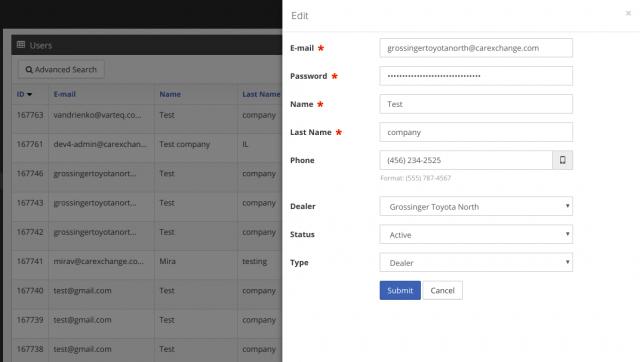
Define how add/edit/info forms are displayed:
mode = "new"Values:
* new - opens in a new page
* right - slides out from the right
* (unspecified) - opens in a modal
Attribute js
For custom action buttons, triggers specified JavaScript function.
$model['actions'] = [
    'archive' => [
        'type'    => 'archive',
        'caption' => __('Archive'),
        'js'      => "doArchive(%id%)",
    ]
];
Attribute fast
Displays the add form inline in the list without reloading the page. Only for Store::ACTION_INSERT.
fast = "true"You can also set a custom form:
fast = "forms/fast_insert"In this case, template forms/fast_insert.php is used.
Attribute prefill
Pre-fills form with values from the previous entry.
prefill = "true"cancelUrl
Override redirect when pressing Cancel in edit form:
<action type="edit"
        mode="new"
        caption="<?php echo __('Edit')?>"
        title="<?php echo __('Edit Request')?>"
        cancelUrl="<?php echo Core::getInstance()->getUrl('/user/requests/'); ?>" />
redirectUrl
If you need to change the redirect logic after performing the action.
<action type="insert"
        caption="<?php echo __('Add'); ?>"
        redirectUrl="<?php echo Core::getInstance()->getUrl('/company/%s/journal/', $id); ?>" />
button
Text for the button in the action form. Default: Submit.
icon
By default, use save icon for insert and edit actions that include fa-save css class.
menuIcon
Icon-font name drawn before the action's caption in the row actions menu, e.g. pencil. icon stays
with the form's action button. Builder: ->menuIcon('pencil').
Constant: IActionAttributes::OPTION_MENU_ICON.
variant
Sets the look of an action. A renderer draws the action in the colour of its variant. Builder:
->variant(ActionVariant::DANGER). Constant: IActionAttributes::OPTION_VARIANT. Read it with
ActionOptions::getVariant().
The values are the cases of Festi\Store\View\ActionVariant: default, primary, success, info,
warning and danger. Use primary for the main action of a list and danger for an action that
destroys data.
The remove action is danger when it declares no variant. Another action without a variant has
null, and getVariant() returns DEFAULT. A value that is not a variant counts as not declared.
<action type="insert" caption="<?php echo __('Add'); ?>" variant="primary" />
<action type="remove" caption="<?php echo __('Delete'); ?>" variant="danger" />
<action type="archive" caption="<?php echo __('Archive'); ?>" variant="warning" js="archive(%id%)" />
$actions->add(Store::ACTION_REMOVE)
->caption(__('Delete'))
->variant(ActionVariant::DANGER);Core sets variant on every action it prepares: the actions above the list and the row actions. A
listener that adds an action as a plain array can put a string or an ActionVariant case in it.
attributes
Core sets attributes (ActionOptions::ATTRIBUTES) on every action it prepares. A schema does not
declare it. The value is a string of the escaped HTML attributes of the action link, ready to print.
It has data-action-name and, when confirmDialog is on, the data attributes of the confirmation dialog.
group
Names the group a row action belongs to in the actions menu, e.g. status or danger. Builder:
->group('danger').
Per row the presenter marks the actions that open a new group with isGroupStart
(ActionOptions::IS_GROUP_START), never the one shown first, and a renderer draws its divider from that
flag. So a row offering only some of a group's actions still gets one line in front of the first of
them, and a line for a single action means naming it a group of its own.
$actions->add('duplicate')->menuIcon('files-o');
$actions->add('activate')->menuIcon('check-circle-o')->group('status');
$actions->add('move_to_draft')->menuIcon('file-text-o')->group('status');
$actions->add('archive')->menuIcon('archive')->group('status');
$actions->add(Store::ACTION_REMOVE)->menuIcon('trash-o')->group('danger');
labelWidth and fieldWidth
These attributes control grid layout in the form. They are used to set the width of labels and fields in the form. 1 - 12 columns can be specified, where 12 is the full width of the form.
confirmDialog
If a confirmation dialog is needed before performing the action, use the confirmDialog attribute. To set the title and message, use dialogTitle and dialogMessage.
You can also customize the confirm and cancel button captions using the dialogConfirmButtonCaption and dialogCancelButtonCaption attributes.
<action type="archive"
        caption="<?php echo __('Archive'); ?>"
        link="<?php echo Core::getInstance()->getUrl('/deal/archive/%id%/'); ?>"
        confirmDialog="true"
        dialogTitle="<?php echo __('Are you sure?'); ?>"
        dialogMessage="<?php echo __('Do you really want to archive this deal?'); ?>"
        dialogConfirmButtonCaption="<?php echo __('Yes'); ?>"
        dialogCancelButtonCaption="<?php echo __('No'); ?>" />
Attributes:
- dialogTitle – title of the confirmation dialog.
- dialogMessage – message shown in the dialog.
- dialogConfirmButtonCaption – (optional) text for the confirm button. Defaults to "Ok".
- dialogCancelButtonCaption – (optional) text for the cancel button. Defaults to "Cancel".
link
Specify the URL to which a POST request will be sent with record IDs in the grouped_items parameter.
js
Specify the name of the JavaScript function triggered on bulk action.
columns
Used with sectionIdent mode to define number of columns in form (only in mode="new").
Related to (sections)[./FieldsGrouping.ru.md]
<field  type="text"
        name="country"
        hide="true"
        caption="<?php echo __('Country'); ?>"
        sectionIdent="Bank Details"
        sectionCaption="<?php echo __('Bank Details'); ?>"/>
...
<action type="insert"
        mode="new"
        caption="<?php echo __('Add'); ?>"
        columns="2"
        title="<?php echo __('Add New'); ?>" />
css
Custom CSS class for action button styling.
<action type="insert"
            mode="new"
            caption="<?php echo __('Contact Us')?>"
            cancelUrl="false"
            css="leads-btn leads-background-green" />
Grouped Actions
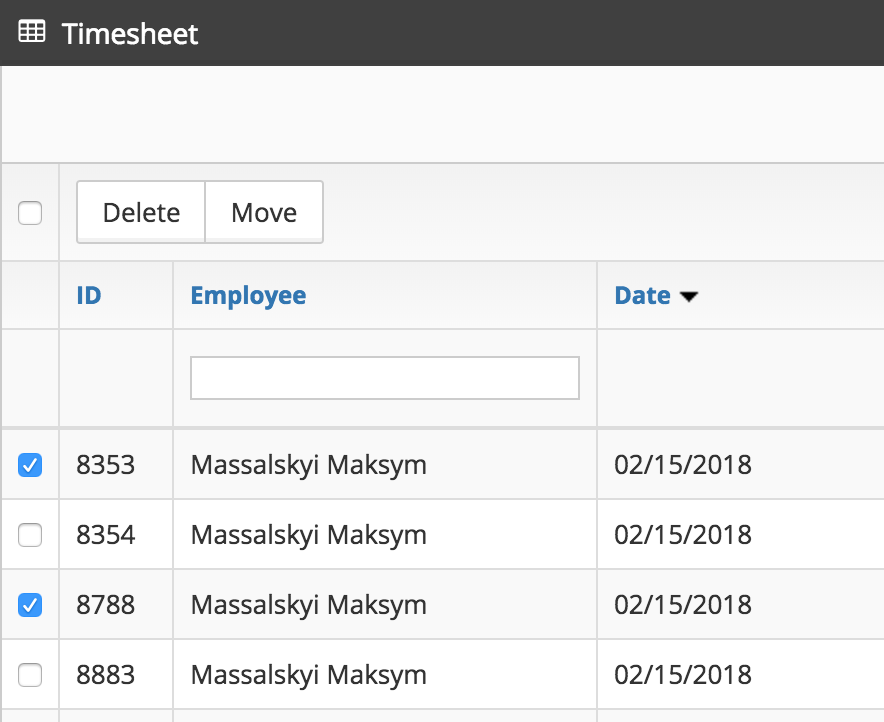
To add bulk actions, use the grouped tag.
<grouped>
    <item caption="<?php echo __('Delete'); ?>"
          type="bulk_delete"
          link="<?php echo $core->getUrl('/test/'); ?>" />

    <item caption="<?php echo __('Move'); ?>"
          type="bulk_move"
          js="js_handler_function_name" />
</grouped>
Attributes:
caption– Label shown on the grouped action button (required)type– Unique identifier for the action logic (required)link– URL to be called for server-side actionjs– JavaScript function to execute on clickconfirmDialog– Enables confirmation dialog if set to "true"dialogTitle– Title shown in the confirmation dialogdialogMessage– Message shown in the confirmation dialogpermission– Restricts action visibility to users with a specific permission section
More examples
<grouped>
    <item caption="<?php echo __('Delete Selected'); ?>"
          type="bulk_delete"
          link="<?php echo $core->getUrl('/items/delete/'); ?>"
          confirmDialog="true"
          dialogTitle="<?php echo __('Confirm Deletion'); ?>"
          dialogMessage="<?php echo __('Are you sure you want to delete selected items?'); ?>" />
</grouped>
<grouped>
<item caption="<?php echo __('Move to Archive'); ?>"
type="bulk_move"
js="moveToArchiveHandler" />
</grouped>
Class Schema Form
In a ClassSchema, declare bulk actions from the groupActions() section method. $groupActions->add($type) returns the same IActionDefinition used by row actions — every fluent setter (caption(), url(), js(), confirmDialog(), dialogTitle(), dialogMessage(), permission(), …) is available.
protected function groupActions(IGroupActionsBuilder $groupActions): IGroupActionsBuilder
{
    $groupActions->add('bulk_delete')
        ->caption(__('Delete Selected'))
        ->url($this->core->getUrl('/items/delete/'))
        ->confirmDialog(true)
        ->dialogTitle(__('Confirm Deletion'))
        ->dialogMessage(__('Are you sure you want to delete the selected items?'));

    $groupActions->add('bulk_move')
        ->caption(__('Move to Archive'))
        ->js('moveToArchiveHandler');

    return $groupActions;
}
The output hydrates the same 'grouped' model section the XML loader produces, so the bulk-action template and StoreModel::getGroupActionFields() are unaffected.
Action Items (Nested Sub-Actions)
In DGS, an <action> tag can include one or more <item> children to define sub-actions.
Each sub-action (defined by an <item>) can have its own caption, JavaScript handler, link, icon, and styling, while still being logically tied to the parent action.
Attributes:
id– Unique identifier of the item (required)caption– Button caption (required)url– Target URL for navigationjs– Name of the JavaScript function to trigger on clickcss– Optional CSS class to style the item (e.g., btn btn-default)icon– Optional icon class (e.g., fa fa-plus)
<action type="info" caption="<?php echo __l('More Options'); ?>" mode="new">
    <item id="details" caption="View Details" url="<?php echo $core->getUrl('/delete/%id%'); ?>" />
    <item id="edit" caption="Edit" js="editItem(%id%)" css="btn btn-default" />
    <item id="delete" caption="Delete" js="deleteItem(%id%)" icon="fa fa-trash" />
</action>
Examples of Different Actions
Adding a top button linking to another URL
<action type="create"
        caption="<?php echo __('Create'); ?>"
        view="top"
        link="<?php echo Core::getInstance()->getUrl('/create/'); ?>"
        mode="new" />
Action linking to a specific URL
<action type="test_task"
        caption="<?php echo __('Test Task')?>"
        link="<?php echo Core::getInstance()->getUrl('/user/review/%id%/task/'); ?>"
        mode="new" />
<action type="remove"
caption="<?php echo __('Delete'); ?>"
confirmDialog="true"
dialogTitle="<?php echo __('Are you sure?'); ?>"
dialogMessage="<?php echo __('This action cannot be undone.'); ?>" />
<action type="external"
caption="<?php echo __('Open Docs'); ?>"
view="top"
mode="new"
link="https://docs.example.com/guide" />
<action type="custom"
caption="<?php echo __('Archive'); ?>"
js="archiveSelectedItems(%id%)"
view="top" />
<action type="insert"
caption="<?php echo __('Add and View Journal'); ?>"
redirectUrl="<?php echo Core::getInstance()->getUrl('/company/%s/journal/', $id); ?>" />Removing Row Actions Based on Conditions
Sometimes different rows need different available actions, depending on record data.
For example, hide delete button if status equals created:
- Subscribe to the
Store::EVENT_ON_LIST_ACTIONSevent:
<listeners>
    <listener event="<?php echo Store::EVENT_ON_LIST_ACTIONS; ?>"
              plugin="Finance"
              method="onListActions" />
</listeners>- Define handler:
/**
 * @event Store::EVENT_ON_LIST_ACTIONS
 * @param FestiEvent $event
 * @return bool
 */
public function onListActions(FestiEvent $event): bool
{
    $status = $event->target['values']['status'];
    if ($status !== 'created') {
        return false;
    }

    $actions = &$event->target['actions'];
    $index = array_search(Store::ACTION_REMOVE, $actions);
    unset($actions[$index]);

    return true;
}